
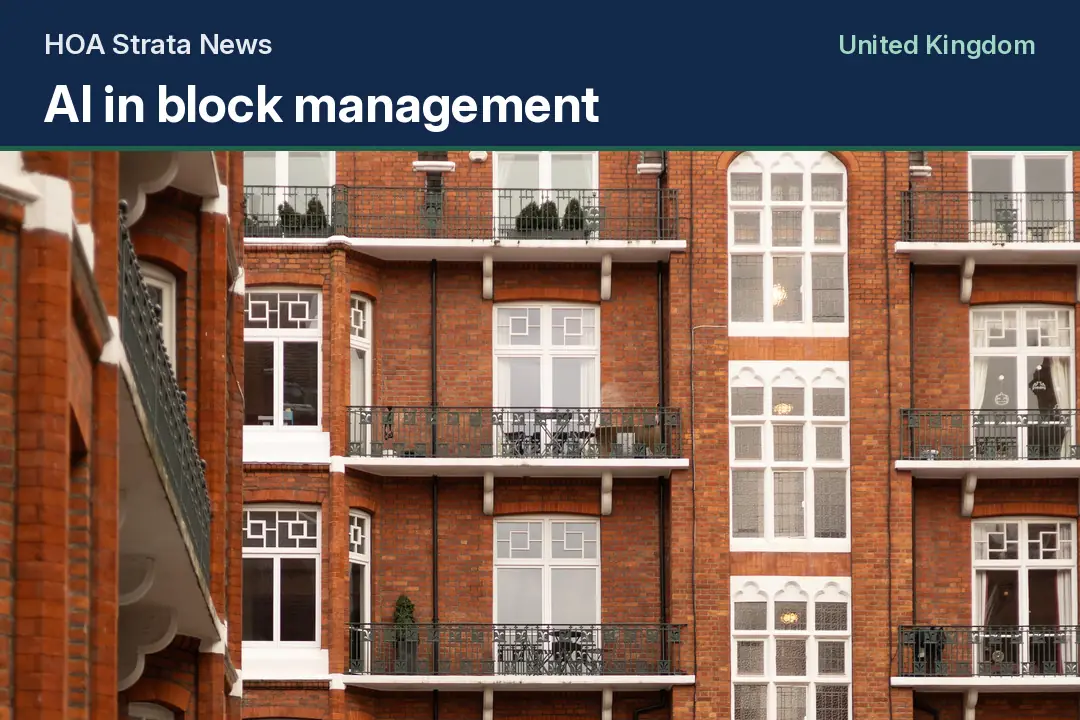
In one sentence: Repairs triage and service charge bookkeeping are the most developed uses.
Published · 9 min read
Short answer: In UK block management, AI in 2026 is mostly used to triage repair reports, match bank lines and invoices to service charge accounts, draft leaseholder emails and extract data from documents. Fixflo, MRI Software and newer platforms such as WiseBlock now offer it. But the landlord, residents’ management company (RMC) or right to manage (RTM) company remains accountable: Section 20 consultation, service charge transparency, company records and UK GDPR all still apply, and the rules on automated decisions changed on 5 February 2026.
Last updated: 20 November 2026.
Why AI matters for UK blocks now
Many blocks of flats in England and Wales are run by a managing agent for a freeholder, or by leaseholders themselves through an RMC or an RTM company with volunteer directors. The work is repetitive: repair reports, service charge demands, year-end accounts, Section 20 notices and a steady stream of leaseholder questions. Reform is adding more. Service charge transparency rules under the Leasehold and Freehold Reform Act 2024 are being phased in, and the Commonhold and Leasehold Reform Bill is before Parliament.
The industry is still working out its approach. The Property Institute (TPI), the main trade body for residential managing agents, included a session on AI in property management at its 2026 annual conference (TPI), but we did not find a dedicated TPI guidance note on AI for managing agents.
Six practical uses in UK block management
1. Repairs reporting and triage
This is the most mature area. Fixflo says its Aidenn assistant, trained on more than 75,000 real repair issues, analyses residents’ photos and descriptions, suggests make-safe steps in over 200 languages, can escalate to video triage, and produces a job report that sits in Fixflo for the manager to review and instruct a contractor; it also says it uses UK data centres (Fixflo; Fixflo help centre). WiseBlock says its Maintenance Surveyor drafts a job from repair photos but saves nothing until someone checks it (WiseBlock).
2. Service charge bookkeeping
Bank reconciliation and invoice handling take hours each month. WiseBlock says its Bank Specialist reads bank statements and matches lines for reconciliation, flagging uncertain lines for review, while contractor invoices are approved by a person before they reach the ledger. London block manager JAR, which looks after more than 6,500 homes, has adopted MRI’s Agora Orchestrator for accounting tasks, maintenance triage and document processing; MRI says JAR’s own preliminary assessment points to a potential return on investment of about 250% (MRI Software, 6 October 2026). That is an estimate, not a measured result.
Whatever software codes the costs, leaseholders keep their rights. A tenant who has obtained a summary of relevant costs may, within six months, require the landlord to provide reasonable facilities to inspect the accounts, receipts and other supporting documents (Landlord and Tenant Act 1985, s 22). AI-coded invoices must therefore be traceable to the real paperwork. Our guide to challenging a service charge explains the tribunal route.
3. Major works and Section 20
AI can assemble a specification summary, track consultation dates and draft notices. It cannot change the process. In England, a landlord must consult before major works if any one leaseholder would pay more than £250, and failing to consult properly can cap what is recoverable unless the tribunal grants dispensation (LTA 1985, s 20; 2003 Regulations, reg 6). A drafting error in a notice is still the landlord’s error. See our Section 20 guide.
4. Board meetings, AGMs and minutes
Many RMCs and all RTM companies are companies, so company law applies to their paperwork. Every company must record minutes of directors’ meetings and keep them for at least ten years (Companies Act 2006, s 248), and must keep records of resolutions and general meetings for at least ten years (s 355). AI note-takers can produce a useful first draft, but directors should check every resolution and vote before approving the minutes, and agree in advance whether meetings may be recorded. Our right to manage guide covers how RTM companies run.
5. Leaseholder communications
Assistants that draft replies from a building’s own documents can help directors and agents answer the same questions about service charges, repairs and insurance. WiseBlock says its AI Receptionist answers residents by chat and voice using their own account and passes anything it cannot settle to the team. Check that any bot makes clear it is automated and that leaseholders can easily reach a person.
6. Arrears and compliance
Automated reminders are common, and WiseBlock offers scripted voice calls to residents above an arrears threshold that the agent sets, with an opt-out. Escalation beyond reminders, such as referral to solicitors or tribunal proceedings, should be a human decision taken in line with the lease and the law. Compliance calendars for fire risk assessments and insurance renewals are useful, but they remind; they do not prove compliance.
What the platforms say they offer
| Platform | What the vendor says its AI does | Notes (checked 20 Nov 2026) |
|---|---|---|
| Fixflo (Aidenn) | Repairs diagnosis from photos and text, make-safe advice, video triage escalation, job reports for contractors. | Says it uses UK data centres; capacity claims on its site are sales statements. |
| MRI Software (Agora Orchestrator, Qube PM) | Agentic workflows for accounting, maintenance triage and document processing, with human review for sensitive cases. | JAR’s ~250% ROI is a preliminary client estimate (MRI). Qube PM is MRI’s UK block management system (MRI). |
| WiseBlock | Email triage, bank reconciliation, arrears calls, photo-based repair drafts, contractor matching, resident chat. | Every agent is off until switched on; awards over a building’s approval limit need a named person. |
| Blockman | No AI features listed on its feature pages when we checked (Blockman). | Included for comparison only. |
Inclusion is not an endorsement or a ranking. For the US market, where AI platforms are further along, see our US guide to AI in HOA management.
Data protection: UK GDPR and the 2026 changes
Managing agents, RMCs and RTM companies handle leaseholders’ names, contact details, payment histories and sometimes health or vulnerability information. UK GDPR and the Data Protection Act 2018 apply to that data whichever tool processes it. Section 80 of the Data (Use and Access) Act 2025 replaced Article 22 of UK GDPR with new Articles 22A to 22D (DUAA 2025, s 80), in force from 5 February 2026 (SI 2026/82). Where a significant decision is based solely on automated processing, controllers must provide safeguards, including letting the person make representations, obtain human intervention and contest the decision, and stricter limits apply where special category data is involved.
The ICO says its guidance on AI and data protection is under review because of the Act (ICO), and it consulted in 2026 on new guidance on automated decision-making (ICO). The practical message for blocks is simple: keep a person meaningfully involved in decisions about a leaseholder’s money or rights, and do not paste personal data into public chatbots.
How to start: volunteer RMC or RTM vs managing agent
Volunteer-run RMCs and RTM companies
- Use AI to draft newsletters, AGM notices and plain-English explanations of the budget, then check them.
- Ask your managing agent which AI tools touch your building’s data and leaseholders’ details.
- Approve a short AI and data policy at a board meeting and minute it.
- Keep Section 20 and any arrears action under director control.
Managing agents
- Pilot one workflow, such as repairs triage or bank reconciliation, and measure accuracy.
- Set approval limits for spending and log every AI action.
- Update privacy notices and check whether any process makes solely automated significant decisions.
- Report results and errors to client boards.
Questions to ask a block management software provider
- Which tasks does the AI complete itself, and which does it only draft for approval?
- Where is our data processed and stored, and is it used to train models?
- Can every AI-coded invoice be traced to the original document for a Section 22 inspection?
- How do you handle Section 20 timetables and notices?
- Can we set approval limits and see an audit log of AI actions?
- How do leaseholders reach a person, and can they opt out of automated calls?
- What does AI usage cost beyond the base fee?
- What happens to our data if we change agent or software?
The bottom line
AI can lighten the load on managing agents and volunteer directors, especially for repairs reports, bookkeeping and correspondence. Treat vendor figures as claims, keep leaseholders’ statutory rights and Section 20 under human control, check minutes before they become ten-year company records, and make sure any automated decision about a leaseholder has a real person behind it. In Scotland, where blocks are run by property factors under a separate regime, see our guide to property factors.
Can an RMC or RTM company use AI to take minutes?
Yes, as a draft. Directors must check every resolution and vote before approving them, because company law requires minutes of directors’ meetings and records of resolutions to be kept for at least ten years.
Can a managing agent use AI to decide service charge arrears action?
It can send reminders and flag accounts, but decisions with significant effects on a leaseholder should involve a person. Since 5 February 2026, solely automated significant decisions under UK GDPR need safeguards including human intervention and the right to contest.
Can AI write Section 20 notices?
It can produce a draft, but the landlord remains responsible for the content and the statutory timetable. Getting consultation wrong can cap recovery at £250 per leaseholder unless the tribunal grants dispensation.
Is it safe to paste leaseholder details into ChatGPT?
Avoid it. Personal data should only go into tools covered by a contract that protects it and says how it is stored and whether it is used for training.
Does The Property Institute have AI guidance?
We did not find a dedicated TPI guidance note on AI when we checked in November 2026, although AI in property management was on its 2026 conference programme.
Last reviewed: November 2026. General information, not legal, tax or financial advice. Laws change and your governing documents matter, so check the current law and your own by-laws, declaration or lease before you act. How we check facts: Editorial Standards.
Sources
- Fixflo: Aidenn AI repairs and maintenance (fixflo.com)
- Fixflo help centre: AI reporting, what happens when an issue is reported (help.fixflo.com)
- MRI Software: JAR adopts MRI agentic AI (6 Oct 2026) (mrisoftware.com)
- MRI Software: Qube Property Management (mrisoftware.com)
- WiseBlock: AI agents (wiseblock.co.uk)
- Blockman: Software features (blockman.co.uk)
- The Property Institute: Annual Conference 2026 programme (tpi.org.uk)
- Landlord and Tenant Act 1985, s 20 (legislation.gov.uk)
- Service Charges (Consultation Requirements) (England) Regulations 2003, reg 6 (legislation.gov.uk)
- Landlord and Tenant Act 1985, s 22 (legislation.gov.uk)
- Companies Act 2006, s 248 (legislation.gov.uk)
- Companies Act 2006, s 355 (legislation.gov.uk)
- Data Protection Act 2018 (legislation.gov.uk)
- Data (Use and Access) Act 2025, s 80 (legislation.gov.uk)
- The Data (Use and Access) Act 2025 (Commencement No. 6) Regulations 2026 (legislation.gov.uk)
- ICO: Guidance on AI and data protection (ico.org.uk)
- ICO: The Data (Use and Access) Act 2025, what it means for organisations (ico.org.uk)
- ICO: Consultation on draft automated decision-making guidance (2026) (ico.org.uk)
Related on HOA Strata News
- Section 20 Major Works Consultation
- How to Challenge a Service Charge in England and Wales
- Right to Manage Explained
- AI for HOA Management in 2026 (United States)
Keep reading

Why Has Leasehold Buildings Insurance Gone Up? Cladding, Commissions and the FCA Rules

Why Are Service Charges So High? Insurance, Major Works and What You Can Challenge

England to Make Leasehold Reserve Funds Mandatory and Overhaul Section 20 Major Works

Commonhold and Leasehold Reform Bill Enters Parliament: What It Means for Leaseholders