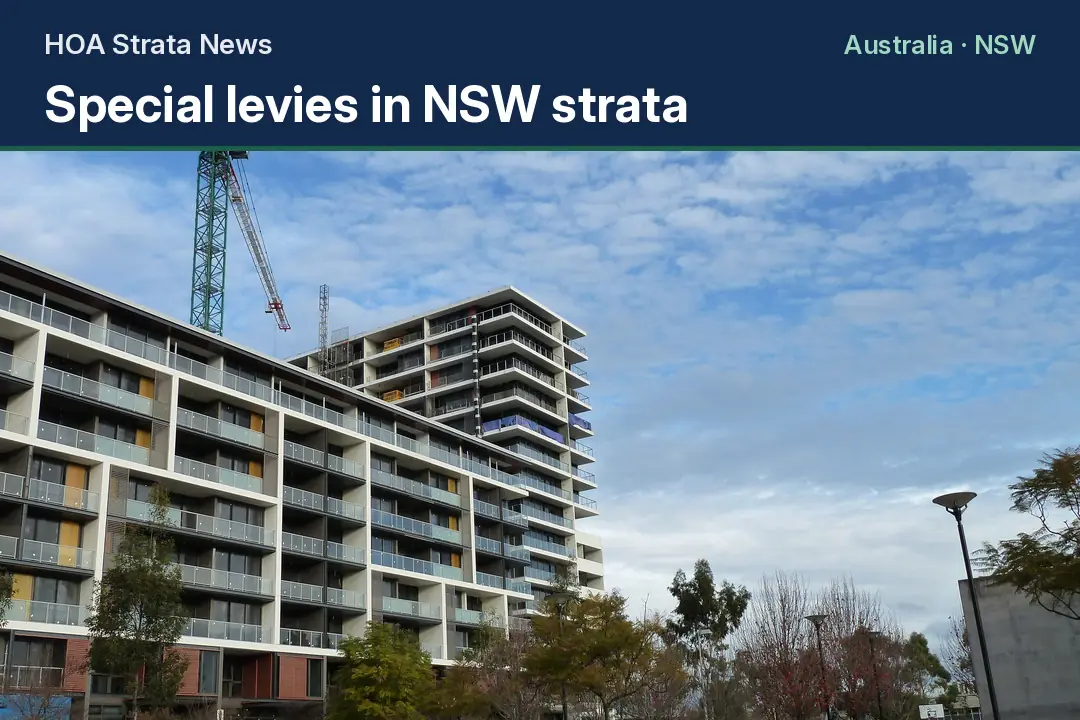
In one sentence: Only the owners at a general meeting can impose a special levy. The strata committee can propose one, but it can't decide it alone (s 81(4); NSW Fair Trading).
Last reviewed · Primary source: Strata Schemes Management Act 2015 (NSW) · all sources
Published · 10 min read
Short answer: A special levy is an extra contribution the owners corporation raises when its administrative fund or capital works fund can’t cover an expense. In NSW it must be decided at a general meeting of owners, not by the strata committee alone (SSMA s 81(4)). It’s shared by unit entitlement, and owners must get written notice at least 30 days before payment is due, or 14 days for emergency repairs (s 83). There’s no cap on the amount. Late payments attract 10% simple interest after one month (s 85).
Last updated: 23 November 2026. Legislation and NSW Fair Trading guidance checked 23 November 2026.
The letter usually arrives after a building report. Waterproofing has failed on the balconies, the lift needs replacing, or a fire-safety order has to be met by a deadline. The capital works fund holds a fraction of the cost, and the strata manager puts a motion on the agenda: a special levy of several thousand dollars per lot, payable in instalments.
NSW law gives owners a vote and a few firm protections, but no cap. Here is how a special levy has to be raised, how your share is worked out, and what you can do if you think it’s wrong or can’t pay it.
What counts as a special levy
“Special levy” isn’t a term the Strata Schemes Management Act 2015 uses. Legally, it’s an extra contribution to the administrative fund or the capital works fund. Section 81(4) says that if the owners corporation faces expenses “it cannot at once meet from either fund,” it must levy each lot owner a contribution, “determined at a general meeting,” to meet them (s 81(4)). NSW Fair Trading calls this a special levy and says it is used when there isn’t enough money for expenses such as major repairs (NSW Fair Trading).
Regular levies, by contrast, are set at the annual general meeting from the budget estimates for both funds (s 79, s 81(1)–(2)). The 10-year capital works fund plan is supposed to forecast big projects so they can be paid for through regular levies (s 80). A special levy is often a sign that the plan wasn’t followed, wasn’t funded, or missed something.
NSW special levy requirements at a glance
| Requirement | What the law says | Where |
|---|---|---|
| Who decides | The owners corporation at a general meeting (an AGM or an extraordinary general meeting) | SSMA s 81(4) |
| Notice of the meeting | At least 14 days before an AGM, at least 7 days before any other general meeting; the agenda must include the motion | SSMA Sch 1 cl 7 |
| Vote needed | A motion passed by a majority; Fair Trading’s guidance is that over 50% must vote in favour to approve a levy | NSW Fair Trading |
| How it’s split | In proportion to each lot’s unit entitlement | s 83(2) |
| Notice to pay | Written levy notice; due date at least 30 days after the notice, or at least 14 days for emergency repairs | s 83(1), (3A) |
| Instalments | Allowed if the meeting’s decision sets them | s 81(5) |
| Hardship information | Levy notices must include a Financial Hardship Information Statement or its contents | NSW Fair Trading |
| Late payment | 10% simple interest, but none if paid within one month of the due date; the owners corporation can resolve to charge no interest | s 85(1)–(3) |
| Early payment | The meeting may allow a 10% discount for paying before the due date | s 85(4) |
| Recovery | At least 30 days’ notice before recovery action; no action while an agreed payment plan is being followed | s 86(4), (6) |
| Cap on the amount | None |
“Emergency repairs” has a narrow meaning: urgent repairs to a building that are needed to mitigate a serious and imminent threat to the health or safety of occupants (s 83(5)). A cosmetic repaint or a planned lift upgrade doesn’t qualify for the shorter 14-day notice.
Worked example: what your lot pays
Suppose a 40-lot building in Sydney’s inner west needs $600,000 of balcony waterproofing and façade repairs. The capital works fund can contribute $150,000 without leaving the fund short, so the owners vote on a $450,000 special levy, to be paid in four quarterly instalments.
| Lot | Unit entitlement | Share of 10,000 | Total levy | Each of 4 instalments |
|---|---|---|---|---|
| One-bedroom | 180 | 1.8% | $8,100 | $2,025 |
| Two-bedroom | 260 | 2.6% | $11,700 | $2,925 |
| Three-bedroom penthouse | 420 | 4.2% | $18,900 | $4,725 |
The method is the one Fair Trading sets out for regular levies: divide the amount needed by the scheme’s total unit entitlement, then multiply by each lot’s entitlement (NSW Fair Trading). Your entitlement is on the strata plan’s schedule of unit entitlement. If the meeting also approves the 10% early-payment discount, the two-bedroom owner who pays in full before the first due date would pay $10,530 instead of $11,700.
Can the strata committee impose a special levy on its own?
No. Section 81(4) requires the contribution to be “determined at a general meeting of the owners corporation,” and Fair Trading’s guidance says special levies “must be introduced at a general meeting” (NSW Fair Trading). The committee can obtain quotes, prepare the motion and recommend an amount. If a levy notice arrives without a general meeting having approved it, ask the strata manager for the minutes showing the resolution before you pay.
Emergency work is the main grey area. The committee may need to act fast on an urgent repair, but the special levy to pay for it still needs a general meeting. The shorter 14-day notice only shortens the time to pay once the levy has been approved.
Your rights before and after the vote
- Read the agenda and supporting papers. Ask for the quotes, the engineer’s or building report, the current balance of the capital works fund and the 10-year plan. Our guide to reading a strata report shows where those numbers sit.
- Propose amendments. Owners can move to spread the levy over more instalments, to stage the works, or to use a strata finance loan. Fair Trading suggests committees consider instalments and finance to limit financial pressure on owners.
- Vote, or appoint a proxy. Owners who are behind on their levies are unfinancial and lose the right to vote at meetings, according to Fair Trading’s guidance, so clear any arrears before the meeting if you want a say.
- Challenge an excessive levy. If you believe the amount is excessive or the manner of payment unreasonable, NCAT can order a contribution of a different amount or paid in a different way (s 87). Fair Trading offers free mediation for many levy disputes first (NSW Fair Trading).
- Keep paying while you dispute. Fair Trading warns that withholding levies because of a dispute exposes you to interest and debt recovery.
If you can’t pay a special levy
Talk to the strata manager or committee early, before the due date if you can. A payment plan can run for up to 12 months, and a further plan can be agreed after that (s 85(5AA)). The owners corporation can’t charge a fee for a plan, must reply to a completed request within 28 days, and must give reasons if it refuses (Regulation cll 18A–18B). The Regulation says a refusal is reasonable if the plan would leave the capital works fund or the administrative fund short (cl 17J). If NCAT finds a refusal unreasonable, it can order the owners corporation to agree to the plan (s 85(9)).
NSW Fair Trading says the payment-plan rules are being widened so a plan can cover current levies and interest, not only overdue levies. Until its updated request form is published, owners should use the current form and raise current levies or interest directly with the committee or strata manager (NSW Fair Trading). We covered the change in Can’t pay your strata fees in NSW? The free National Debt Helpline is on 1800 007 007.
Buying or selling when a special levy is on the table
A buyer takes on more than the keys. When you become the owner of a lot, you are jointly and severally liable with the previous owner for any contribution, and interest, that the previous owner already owed (s 84(1)). A strata information certificate must show any unpaid special levy under section 81(4) and the date it was levied (s 184(3)(d)).
- Ask for the certificate and the minutes of the last two years of general meetings, looking for approved or proposed levies.
- Check the 10-year plan for big items that the capital works fund can’t cover; that’s where the next levy usually comes from.
- Agree in writing with the other party, through your conveyancer or solicitor, who pays instalments falling due before and after settlement.
- Read our strata fees explainer for the regular levy side of the budget.
Tax, briefly
For a rental property, the ATO treats a special levy for capital works, such as a new roof, as not immediately deductible; it may be claimed as capital works deductions once the work is done. Levies for repairs and day-to-day costs are treated differently. Our guide to whether strata fees are tax deductible covers the ATO rules.
How NSW compares with Victoria and Queensland
| NSW | Victoria | Queensland | |
|---|---|---|---|
| Name | Special levy (contribution under s 81(4)) | Special fee or charge | Special contribution |
| Who decides | Owners at a general meeting | Owners corporation; a special resolution is needed if proposed special fees are more than double the current annual fees | Body corporate by ordinary resolution |
| Source | SSMA 2015 s 81 | Consumer Affairs Victoria | Queensland Government |
This article is general information about NSW strata law, not legal or financial advice. A strata lawyer or NSW Fair Trading can help with your scheme’s specific situation.
Frequently asked questions
Can a strata committee raise a special levy in NSW?
No. Under section 81(4) of the Strata Schemes Management Act 2015, a special levy must be determined at a general meeting of the owners corporation. The committee can propose it and prepare the motion, but the owners decide.
How much notice do I get for a special levy in NSW?
The levy notice must give you at least 30 days to pay. For emergency repairs, meaning urgent repairs needed to mitigate a serious and imminent threat to occupants’ health or safety, the minimum is 14 days.
Is there a limit on how much a special levy can be in NSW?
No. The Act sets no dollar or percentage cap. If you believe a levy is excessive or the payment method unreasonable, you can apply to NCAT, which can order a different amount or method of payment under section 87.
How is my share of a special levy worked out?
By unit entitlement. Divide the total levy by the scheme’s total unit entitlement and multiply by your lot’s entitlement, which is shown on the strata plan.
What happens if I don’t pay a special levy on time?
Interest at 10% a year applies if the levy is not paid within one month of the due date, you become an unfinancial owner and lose your vote at meetings, and the owners corporation can start recovery action after giving 30 days’ notice. Ask for a payment plan early.
Does the buyer or seller pay a special levy in NSW?
The Act makes a new owner jointly and severally liable for contributions already owing when they become the owner. Who bears instalments before and after settlement should be agreed in the contract, so check the strata information certificate and talk to your conveyancer.
Sources
- Strata Schemes Management Act 2015 (NSW), ss 79–87, 184 and Sch 1 cl 7, legislation.nsw.gov.au
- Strata Schemes Management Regulation 2016 (NSW), cll 17J–18B and 19
- NSW Fair Trading: Levies (information for strata committees, updated 27 October 2025)
- NSW Fair Trading: Help if you can’t pay your strata levies (updated 27 October 2025)
- NSW Government: Guide to strata law changes for strata committees and owners (updated 26 October 2026)
- Consumer Affairs Victoria: Owners corporation fees
- Queensland Government: Body corporate fees for owners
Related on HOA Strata News
- Strata Fees Explained: What You Pay in NSW, Victoria and Queensland
- Can’t Pay Your Strata Fees in NSW? New Payment Plan Rules
- Special Assessment and Special Levy Tracker 2026
- How to Read a Strata Report Before Buying in NSW