In one sentence: Section 153 of the Strata Schemes Management Act 2015 prohibits using a lot in a way that causes a nuisance or hazard to another occupier. Its note mentions smoke penetration as a possible nuisance.
Published · 6 min read
Short answer: Often yes. Under section 153 of the Strata Schemes Management Act 2015, an owner or occupier must not use their lot in a way that causes a nuisance or hazard to another occupier, and the Act’s own note says smoke penetrating other lots may be a nuisance. Many schemes also have a by-law based on the NSW model smoke-penetration by-law. NCAT has ordered residents to stop smoking on a balcony where the smoke reached a neighbour’s unit.
Last updated: November 3, 2026.
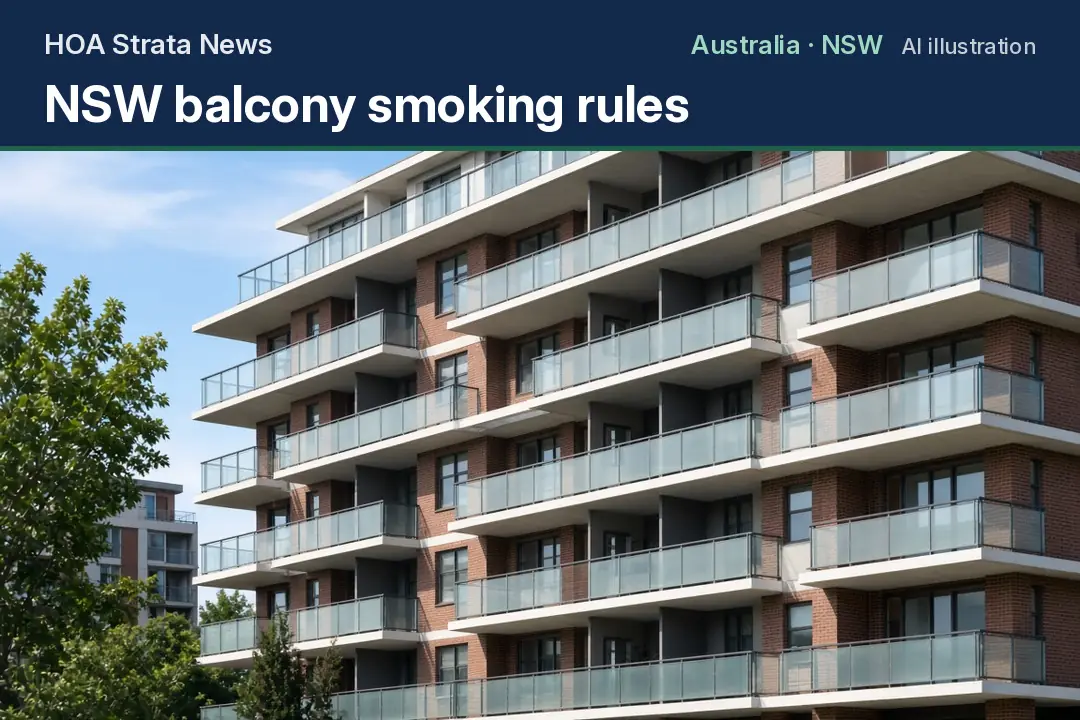
Balcony smoking is one of the most common neighbour disputes in NSW apartment buildings. The smoker feels they’re on their own property; the neighbour upstairs can’t open their windows. NSW strata law sides with neither by default. Instead, it asks whether the smoke is reaching other lots or common property, and what your scheme’s by-laws say. This guide walks through the nuisance rule, the model by-law, how enforcement works, and two Tribunal decisions that show how these disputes play out.
The law without a by-law: nuisance
Section 153(1) says an owner, mortgagee in possession, tenant or occupier of a lot must not (a) use or enjoy the lot, or permit it to be used or enjoyed, in a manner or for a purpose that causes a nuisance or hazard to the occupier of any other lot; (b) use or enjoy the common property in a way that unreasonably interferes with another person’s use or enjoyment of it; or (c) use or enjoy the lot or common property in a way that unreasonably interferes with another occupier’s use or enjoyment of their lot or the common property. The note to the section says the penetration of smoke into another lot may be a nuisance.
That matters because section 153 applies in every scheme, whether or not your by-laws say anything about smoking. A neighbour doesn’t need a smoking by-law to complain; they need to show the smoke is causing a nuisance or hazard, or unreasonably interfering with their use of their lot.
The model smoking by-law
Schedule 3 of the Strata Schemes Management Regulation 2016 contains model by-laws. Model by-law 9, “Smoke penetration”, has two options:
- Option A: an owner, occupier or invitee must not smoke on common property, and an occupier must ensure smoke from smoking on their lot doesn’t penetrate common property or any other lot.
- Option B: smoking on common property is allowed only in a designated smoking area or with the owners corporation’s written approval, and smoke from a lot still mustn’t penetrate common property or another lot.
The model by-law states that if no option is selected, Option A applies. A balcony is usually part of the lot, not common property, so under either option the key question is whether your smoke reaches common property or another lot. Many schemes use their own wording, so get a copy of your registered by-laws from your strata manager or NSW Land Registry Services.
Could a by-law ban smoking entirely?
Section 139 says a by-law must not be harsh, unconscionable or oppressive, and section 150 lets NCAT declare a by-law invalid on those grounds. Whether a total ban on smoking inside a lot would survive a challenge depends on its wording and the facts, so a scheme considering a stricter by-law should take legal advice first.
How enforcement works
- Notice to comply. Under section 146, the owners corporation can give a notice to comply with a by-law, but only after a resolution of a general meeting or the strata committee. The notice must be in the approved form and include a copy of the by-law.
- Mediation. Under the Act’s dispute provisions, NCAT’s registrar must refuse to deal with a matter if satisfied that mediation was appropriate and wasn’t attempted. Mediation can be arranged through NSW Fair Trading. See the NSW Government strata disputes page.
- NCAT penalty. Under section 147, if the notice is breached, NCAT can impose a penalty of up to 10 penalty units, or 20 for a further breach within 12 months of an earlier penalty. The application has to be made within 12 months of the notice.
- Orders. A neighbour, or the owners corporation, can also ask NCAT for orders to resolve the dispute, including orders based on the section 153 nuisance rule.
What NCAT has decided
In Pittman v Newport [2022] NSWCATCD 173, the applicants lived in unit 301 and the respondents in unit 201 directly below, with balconies roughly 4 metres apart. The Tribunal found the smoke was a nuisance under section 153(1)(a) and ordered the respondents not to smoke on their balcony and not to allow smoke from inside their unit to penetrate unit 301.
In Shaw v Euen [2023] NSWCATCD 68, NCAT ordered the owner and occupant of a ground-level lot not to cause or permit tobacco smoking in their courtyard, finding the smoke drifting up to the applicant’s lot, no more than about 6 metres away, was a nuisance and a hazard under section 153(1)(a).
These are Tribunal decisions on their own facts, not binding rules. They show that evidence matters. In Shaw v Euen, the Tribunal relied on the applicant’s sworn evidence, photos of the neighbour smoking in the courtyard over about a year, and his history of written complaints to the strata and building managers.
Practical steps if smoke is coming into your unit
- Talk to the neighbour first, calmly and in writing if possible.
- Keep a log of dates, times and how the smoke entered.
- Check your registered by-laws for a smoking or smoke-penetration by-law.
- Write to the strata committee or strata manager asking it to consider a notice to comply.
- Apply for Fair Trading mediation, and if that fails, apply to NCAT.
Changing the by-laws
Under section 141, owners can add or amend a by-law by special resolution at a general meeting. The change has no effect until a notice of it is recorded by the Registrar-General, and the owners corporation must lodge that notice within 6 months of the resolution.
Related: pets in strata, NSW strata reforms and the NSW strata report guide.
Frequently asked questions
Can strata ban smoking inside my own unit?
A by-law can prevent smoke from your lot penetrating other lots or common property. Whether a total ban inside a lot is valid depends on its wording. Under sections 139 and 150, NCAT can declare a by-law invalid if it is harsh, unconscionable or oppressive.
What if my neighbour is a tenant?
By-laws and section 153 apply to tenants too. Section 153 expressly covers tenants and occupiers, and by-laws bind occupiers too.
Is there a fine for breaching a by-law?
The owners corporation can’t fine you itself. If you breach a notice to comply, NCAT can impose a penalty of up to 10 penalty units, or 20 for a repeat breach within 12 months.
Sources
- Strata Schemes Management Act 2015 (NSW) ss 139, 141, 146, 147, 150, 153 (legislation.nsw.gov.au)
- Strata Schemes Management Regulation 2016 (NSW) Sch 3 (classic.austlii.edu.au)
- NSW Government: Strata by-laws (nsw.gov.au)
- NSW Government: Strata disputes (nsw.gov.au)
- Pittman v Newport [2022] NSWCATCD 173 (decision PDF)
- Shaw v Euen [2023] NSWCATCD 68 (decision PDF)
Related on HOA Strata News
- Pets in Strata: The Rules in NSW, Victoria and Queensland
- NSW Strata Report Guide
- NSW Strata Reforms 2026
Last reviewed: November 2026. General information, not legal advice. Laws change and your governing documents matter, so check the current statute and your own declaration, bylaws or by-laws before you act.