
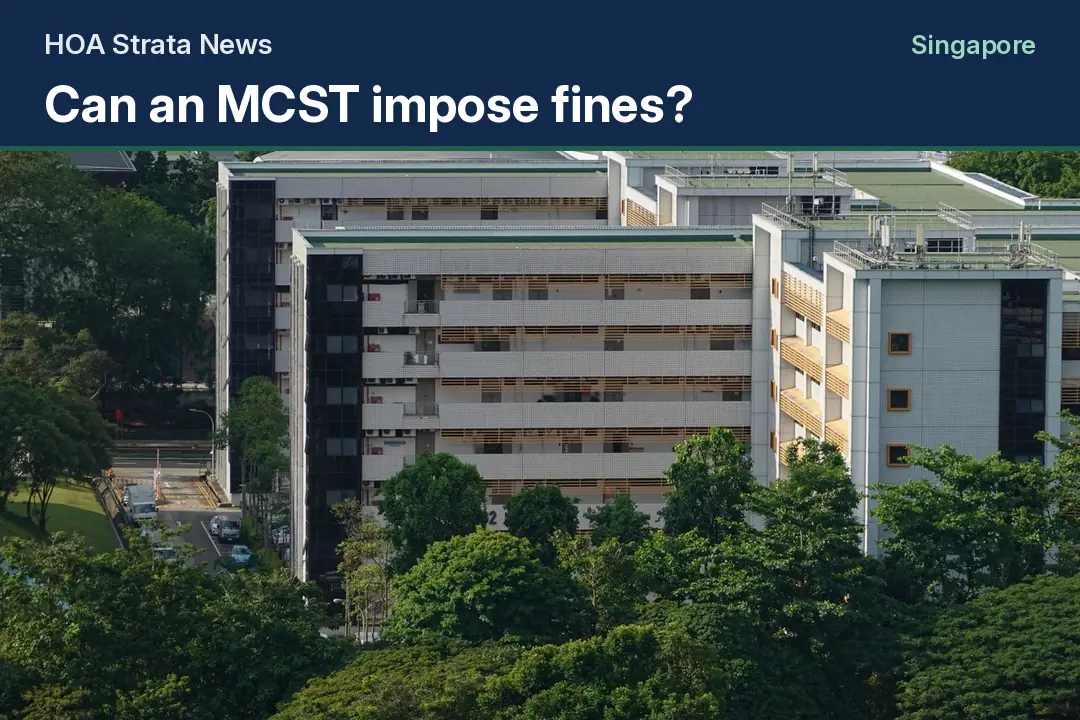
In one sentence: Section 32 of the Building (Strata Management) Act 2004 (BSMA) governs by-laws and their enforcement.
Published · 5 min read
Short answer: No. According to the Building and Construction Authority’s Strata Management Guide on by-laws, a management corporation (MCST) cannot impose fines or forfeit deposits for by-law breaches. It can recover administrative fees to cover costs caused by a breach, and it can apply to the Strata Titles Boards or the court for an order to enforce the by-laws.
Last updated: November 3, 2026.
Many condo residents get a letter saying they’ve been “fined” for a dog mess, parking or a renovation breach. Singapore law is clearer than many people think.
What the BCA guide says
The BCA’s Strata Management Guide on by-laws states that MCs do not have powers to impose penalties or fines for non-compliance with by-laws and should not make by-laws providing for them. Under the enforcement section (section 32 of the BSMA, called the Building Maintenance and Strata Management Act until it was renamed on 1 October 2025 (Act 12 of 2020)), it lists four points: MCs cannot impose fines or forfeit deposits; they may recover administrative fees to compensate for costs incurred as a result of a breach; they must be impartial; and they cannot ban subsidiary proprietors from using facilities unless they obtain a court order.
Administrative fees vs fines
An administrative fee must be tied to a real cost. The guide’s examples include an administrative fee of up to $200 to recover cleaning costs where refuse is left on common property or a pet’s mess isn’t cleaned up. A flat “penalty” unrelated to cost is effectively a fine.
How an MCST can enforce by-laws
- Talk to the owner or occupier to resolve the problem.
- Issue a formal written notice requiring compliance.
- If the breach continues, apply to the Strata Titles Boards or the court for an order compelling compliance, restraining the breach or for damages.
By-laws themselves must be valid. Additional by-laws are made by special resolution and have no effect until lodged with the Commissioner of Buildings; the guide says lodgement must be within 45 days of the resolution.
How by-laws are made or changed
According to the BCA guide, most additional by-laws can be created, amended or repealed by a special resolution passed at a general meeting. A special resolution needs at least 21 days’ written notice of the motion, and the support of subsidiary proprietors representing 75% of the share value of all the valid votes cast at the meeting.
The new or changed by-law then only takes effect after a copy, certified as a true copy under the MC’s seal, is lodged with the Commissioner of Buildings within 45 days of the resolution. If your MC is relying on a by-law, it’s reasonable to ask when it was passed and lodged.
What by-laws can’t do
The guide says additional by-laws must not conflict with the BSMA, the prescribed by-laws or any other law, and must be clearly expressed. It gives fines as a specific example: because MCs have no power to impose penalties or fines, they should not pass by-laws providing for them. A by-law that says “offenders will be fined $500” is therefore on shaky ground, however it was voted in.
The guide also lists other limits, including that by-laws cannot destroy or modify easements created under the BSMA or the Land Titles (Strata) Act 1967, and cannot deal with matters outside the MC’s powers. It recommends that MCs review their by-laws with legal advice at least once every two years.
Who else can enforce by-laws
Enforcement isn’t only for the MC. The guide says the MC, a subsidiary proprietor, a mortgagee in possession, a lessee or an occupier of a lot may apply to the Strata Titles Boards or the court for an order to compel compliance, restrain a breach, or recover damages caused by a breach. So if a neighbour’s breach is affecting you and the MC won’t act, you may be able to apply yourself.
The guide also says MCs must be impartial when enforcing by-laws. Selective enforcement against some residents but not others is worth raising with the council or at a general meeting.
Car parks and wheel clamps
Parking is one of the most common sources of “fines”. The guide’s example car-parking by-laws include a wheel-clamping by-law for vehicles that are unauthorised, in the wrong lot, or parked indiscriminately, with the MC entitled to apply to court to enforce it or recover damages. Any release charge should still be tied to actual costs rather than acting as a penalty.
If you’ve been charged a “fine”
- Ask the MC which by-law it relies on and how the amount was calculated.
- Ask whether it’s a cost recovery and request evidence of the costs.
- Ask when the by-law was passed and lodged with the Commissioner of Buildings.
- Raise it at a general meeting or apply to the Strata Titles Boards if unresolved.
More: condo by-laws in Singapore and our MCST guide.
Frequently asked questions
Can an MCST forfeit my renovation deposit?
BCA guidance says MCs cannot forfeit deposits as a penalty. They may recover genuine costs caused by a breach.
Can the MCST ban me from the pool or gym?
Not on its own. The BCA guide says an MC needs a court order to ban a subsidiary proprietor from using facilities.
Where do I complain about my MCST?
Many disputes can go to the Strata Titles Boards. BCA’s Commissioner of Buildings handles some regulatory matters such as by-law lodgement.
Sources
- Building (Strata Management) Act 2004, s 32 (sso.agc.gov.sg)
- BCA Strata Management Guides (Guide 10: By-laws) (www1.bca.gov.sg)
Related on HOA Strata News
Last reviewed: November 2026. General information, not legal advice. Laws change and your governing documents matter, so check the current statute and your own declaration, bylaws or by-laws before you act.
Keep reading
HDB Minimum Occupation Period (MOP) Explained: 5 Years, 10 Years and What You Can Do After
Singapore Condo Facial-Recognition Gate Did Not Need an Owners’ Vote, Strata Titles Board Rules

Singapore Condo Buyers Will See a Capped Maintenance Charge Before They Pay a Booking Fee

Condo Disputes in Singapore: How the Strata Titles Boards Work