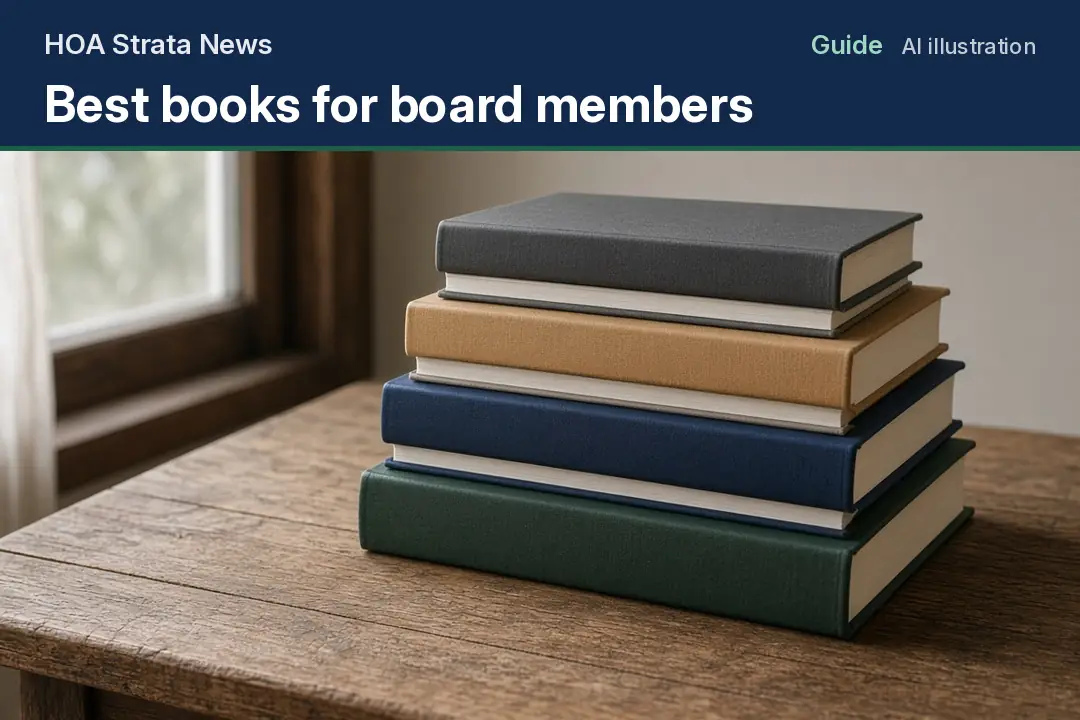
In one sentence: Ten books you can still buy new: four for US HOAs and condos, four for strata and body corporate owners in Canada and Australia, and two on people skills.
Published · 7 min read
Last reviewed: October 2026. Editions, ISBNs and publication dates were checked against publisher and bookseller pages on the date of review. Laws change faster than books, so treat any legal title as background and check current rules with your manager, lawyer or the relevant government site.
As an Amazon Associate we earn from qualifying purchases. Book links on this page go to Amazon.com; buying through them does not change the price you pay or which books we recommend.
There isn’t a big shelf of good books about community associations. Most of what exists is either a slim guide from an industry body or a legal text written for lawyers. That is a pity, because the hardest parts of serving on a board or strata council are rarely in the governing documents: running a meeting people don’t dread, saying no to a neighbour, and explaining why the reserve fund needs more money.
We picked ten books that you can still buy new today. Four are written for U.S. homeowners associations and condos, four for strata and body corporate owners in Canada and Australia, and two cover the people skills every board needs wherever it is. For each one we say who it suits and where it falls short.
For U.S. HOA and condo boards
1. Managing Expectations: A Board’s Guide to the Property Management of Condominiums, Cooperatives, and Homeowners Associations (2023)
Author: Michael Rogoff. Publisher: independently published. ISBN: 979-8-86314-364-4 (paperback).
A short introduction, about 140 pages, to the part of board service that causes the most friction: working with a property manager. Rogoff writes from long experience in the management business and covers communication with residents, budgets and assessments, and handling disputes.
Who it suits: a newly elected director in a managed condo, co-op or HOA who wants to know what to expect from the manager and what the board still has to do itself. It is self-published and written from the manager’s side of the table, so read it as one practitioner’s view rather than a legal guide.
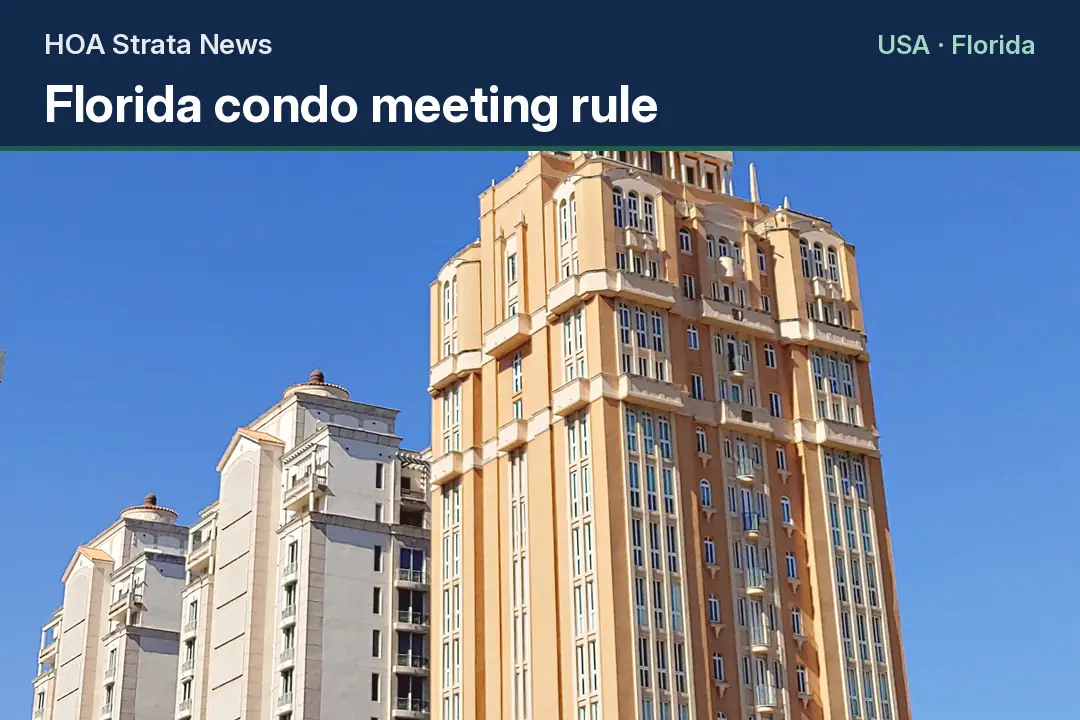
2. The Condominium Concept: A Practical Guide for Officers, Owners, Realtors, Attorneys, and Directors of Florida Condominiums (17th edition, 2024)
Author: Peter M. Dunbar. Publisher: Pineapple Press. ISBN: 978-1-68334-368-4.
The condo companion to the HOA book below, now in its 17th edition and about 400 pages. It is written as a practical guide to how a Florida condominium is run under Chapter 718, for directors, officers and owners rather than for lawyers alone.
Who it suits: Florida condo directors and the realtors and attorneys who work with them. The 2024 edition went to press while Florida was still changing its post-Surfside condo rules, so check reserve, SIRS and milestone inspection details against the current Chapter 718 of the Florida Statutes.
3. Robert’s Rules of Order Newly Revised In Brief (3rd edition, 2020)
Authors: Henry M. Robert III, Daniel H. Honemann, Thomas J. Balch, Daniel E. Seabold and Shmuel Gerber. Publisher: PublicAffairs. ISBN: 978-1-5417-9770-3 (paperback).
Many bylaws say meetings follow Robert’s Rules, and almost nobody on a volunteer board has read the full 700-page manual. This is the authorized short version, about 220 pages, updated to match the 12th edition of the main book. It explains motions, debate, voting, minutes and the duties of the chair and secretary in plain language (Official Robert’s Rules site).
Who it suits: board presidents and secretaries. Check your bylaws and state law first, because some associations use a different rulebook and some statutes override parts of Robert’s Rules.
4. The Law of Florida Homeowners Association (13th edition, 2026)
Authors: Peter M. Dunbar and Charles F. Dudley. Publisher: Pineapple Press. ISBN: 978-1-4930-9192-8.
A revised edition, about 190 pages, published in February 2026, of the long-running guide to Florida’s HOA law. Earlier editions were cross-referenced to the statutes and came with forms associations can adapt; the book covers budgets, meetings, elections and the board’s duties under current Florida law.
Who it suits: Florida HOA boards only. Florida amends Chapter 720 of its statutes almost every year, so check the current text for anything you act on.
For strata and body corporate owners
5. Depreciation Reports in British Columbia (2nd edition, 2024)
Authors: Jeremy Bramwell with Keith Davis. Publisher: Strata Reserve Planning. ISBN: 978-1-7388490-2-4.
A depreciation report is BC’s version of a reserve study. This 154-page guide, updated for the legislative changes that took effect on 1 July 2024, explains how to choose a provider, how the planner builds the report and how to read its conclusions. It includes checklists and worksheets (Strata Reserve Planning).
Who it suits: BC strata councils and treasurers. Owners elsewhere will still find the reasoning about reserve funding useful. The author runs a depreciation report firm, so read it as an informed insider’s view.
6. Body Corporate Practice: A Guide for Committees and Owners (2nd edition, 2025)
Authors: Kim Jordan, Chris Irons, Amanda Farmer, Andrew McNair and others. Publisher: independently published. ISBN: 979-8-28294-429-7 (paperback).
A detailed, 362-page guide to Queensland’s body corporate and community management legislation, written with committees in mind. It covers budgeting, levies, the roles of committee members, changing body corporate managers, difficult people in strata, scheme termination and dispute resolution, with references to adjudication decisions.
Who it suits: Queensland committee members and owners. Owners in other states will find the chapters on budgets and committees useful, but the legal detail is Queensland-specific.
7. Who Runs Your Building? The Committee Member’s Guide to Chairs, Strata Managers and Building Managers (2026)
Author: Rod Adkins. Publisher: Rod Adkins (self-published). ISBN: 978-1-7639117-1-0.
A new, 145-page guide for strata committee members in New South Wales, Victoria and Queensland. It sets out what the committee decides and what only the owners can decide, how the money works, how commissions and conflicts of interest must be disclosed, and how to deal with a chair or inner group that runs everything. It is the second book in the author’s Strata Living, Run Properly series.
Who it suits: owners who have just joined a committee in one of those three states. It was published in October 2026, so it reflects current rules but has few reviews yet.
8. Strata Title Property Rights: Private Governance of Multi-Owned Properties (2017)
Author: Cathy Sherry. Publisher: Routledge. ISBN: 978-0-367-35568-5 (paperback, 2021); hardback 978-1-138-91492-6.
Sherry is an Australian property law academic, and this is the most serious book on the list. It looks at how strata title works as a form of private governance: what owners give up when they buy into a scheme, and how by-laws and collective decisions shape what they can do with their own home (Taylor & Francis).
Who it suits: committee members, lawyers, policy people and owners who want the bigger picture. It is an academic book with academic pricing, not a how-to guide.
For every board: meetings, conflict and negotiation
9. Crucial Conversations: Tools for Talking When Stakes Are High (3rd edition, 2021)
Authors: Joseph Grenny, Kerry Patterson, Ron McMillan, Al Switzler and Emily Gregory. Publisher: McGraw Hill. ISBN: 978-1-260-47418-3.
Not written for associations, but it might as well have been. The book is about conversations where opinions differ, emotions run high and the stakes matter, which describes most special assessment meetings. It teaches how to keep a discussion going without either backing down or blowing up (Crucial Learning).
Who it suits: board presidents, anyone who handles owner complaints, and owners stuck in a dispute with a neighbour or the board.
10. Getting to Yes: Negotiating Agreement Without Giving In (3rd edition, 2011)
Authors: Roger Fisher, William Ury and Bruce Patton. Publisher: Penguin. ISBN: 978-0-14-311875-6.
The classic from the Harvard Negotiation Project, first published in 1981. Its core ideas are to separate the people from the problem, focus on interests rather than positions, and know your alternative before you sit down. That helps with contractor negotiations, developer handovers and disputes between owners.
Who it suits: any board member who negotiates contracts or mediates between owners. It is short, cheap and easy to find second-hand.
Which book to start with
| You are | Start with |
|---|---|
| A new U.S. HOA or condo director | Managing Expectations, then Robert’s Rules In Brief |
| A Florida HOA or condo director | The Law of Florida Homeowners Association or The Condominium Concept, checked against current statutes |
| A BC strata council member | Depreciation Reports in British Columbia, plus the BC government’s free strata housing pages |
| An Australian strata committee member | Who Runs Your Building? (NSW, Vic, Qld) or Body Corporate Practice (Qld), plus your state’s free government guide |
| Anyone dealing with angry meetings | Crucial Conversations |
Books give you the background; your own governing documents and local law decide the details. For the terms used above, see our HOA, condo and strata glossary, and for software and practical tools, our guide to the best tools for HOA board members.
Sources
- Official Robert’s Rules site (robertsrules.com)
- Strata Reserve Planning (stratareserveplanning.com)
- Taylor & Francis (taylorfrancis.com)
- Crucial Learning (cruciallearning.com)