In one sentence: A special assessment is any assessment other than the one required by the annual budget (s. 718.103).
Last reviewed · Primary source: Florida Statutes § 718.103 (definitions) · all sources
Published · 5 min read
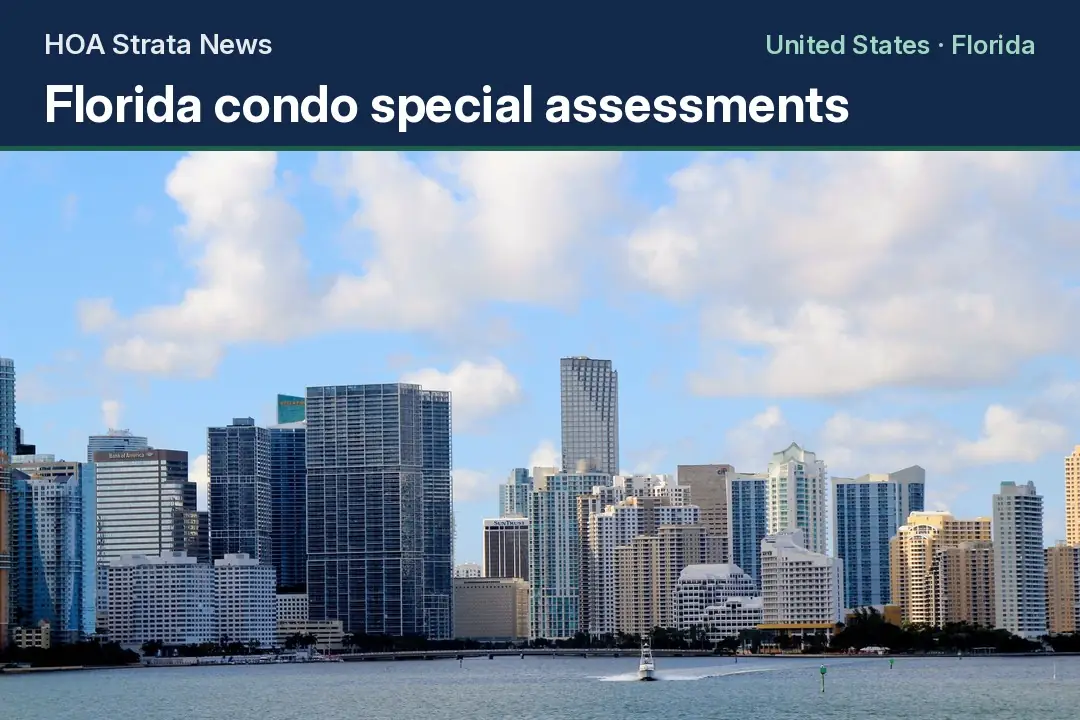
Florida condominiums feature heavily in our Special Assessment Tracker 2026. Milestone inspections and structural integrity reserve studies have pushed many buildings into large, one-off bills. This follow-up explains what the Florida Condominium Act (Chapter 718, Florida Statutes) says about how a special assessment must be noticed, what the money may be spent on, and what happens if an owner cannot pay.
What counts as a special assessment
Florida law defines a special assessment as any assessment levied against a unit owner other than the assessment required by a budget adopted annually (s. 718.103). Who approves it, the board alone or the owners, depends first on your declaration and bylaws. The statute adds notice and spending rules on top.
Notice before the board votes
Written notice of a board meeting at which a non-emergency special assessment will be considered must be mailed, delivered or electronically transmitted to unit owners and posted conspicuously on the condominium property at least 14 days before the meeting. The person giving notice must sign an affidavit of compliance, filed in the association’s official records (s. 718.112(2)(c)1.).
The notice must say specifically that assessments will be considered, and it must give the estimated cost and a description of the purposes (s. 718.112(2)(c)3.).
Owner vote for structural reserve funding
For buildings that must have a structural integrity reserve study, reserves for the required components may be funded by regular assessments, special assessments, lines of credit or loans. A special assessment, line of credit or loan used for this purpose requires approval by a majority vote of the total voting interests of the association (s. 718.112(2)(f)). Any such special assessment, line of credit or loan must also appear in the annual financial statement given to owners and prospective buyers.
The money can only be spent on the stated purpose
The specific purpose or purposes of a special assessment must be set out in a written notice sent or delivered to each owner. The funds may be used only for those purposes. Once the work is done, any excess becomes common surplus, and the board can either return it to owners or credit it against future assessments (s. 718.116(10)).
If you pay late
Assessments and instalments not paid when due bear interest at the rate in the declaration, up to the legal maximum. If the declaration sets no rate, interest runs at 18% a year. If the declaration or bylaws allow, the association may also charge a late fee of up to the greater of $25 or 5% of each late instalment. Payments are applied first to interest, then late fees, then collection costs and attorney fees, and only then to the assessment itself (s. 718.116(3)).
The association has a lien on each unit to secure payment of assessments (s. 718.116(5)). If you rent out your unit and fall behind, the association can demand that your tenant pay the rent directly to it until the debt is cleared (s. 718.116(11)).
Buying or selling with an assessment outstanding
A unit owner is liable for all assessments that come due while they own the unit. A new owner is also jointly and severally liable with the previous owner for unpaid assessments that came due up to the transfer of title, although the new owner can try to recover those amounts from the seller (s. 718.116(1)(a)). Buyers should ask for an estoppel certificate and the latest board minutes before closing.
Questions to ask your board
- Was the meeting noticed 14 days ahead, with the estimated cost and purposes stated?
- Which document gives the board, or the owners, the power to levy this assessment?
- If it funds structural reserves, was it approved by a majority of the total voting interests?
- Is there an instalment plan, and what interest and late fees apply?
- How will any surplus be handled once the work is complete?
How much notice must a Florida condo board give before a special assessment?
At least 14 days’ written notice to owners, also posted on the property, for a meeting at which a non-emergency special assessment will be considered (s. 718.112(2)(c)1.).
Can the association spend special assessment money on something else?
No. The funds may be used only for the purposes in the notice. Any surplus becomes common surplus, to be returned or credited (s. 718.116(10)).
What interest can be charged on a late special assessment?
The rate in the declaration, up to the legal limit, or 18% a year if none is set, plus a late fee of up to the greater of $25 or 5% if the documents allow (s. 718.116(3)).
If I buy a unit, am I liable for the seller’s unpaid special assessment?
Yes. A buyer is jointly and severally liable with the seller for unpaid assessments due up to transfer, with a right to recover from the seller (s. 718.116(1)(a)).
General information, not legal advice. Last updated: 10 November 2026. How we check facts: Editorial Standards.
Sources
- Florida Statutes § 718.103 (definitions) (flsenate.gov)
- Florida Statutes § 718.112 (bylaws; meetings; budgets and reserves) (flsenate.gov)
- Florida Statutes § 718.116 (assessments; liability; lien) (flsenate.gov)
Related on HOA Strata News
- Special Assessment Tracker 2026
- Florida’s SIRS reserve rule in 2026
- Special assessments explained
- Galleon condo’s $36 million repair